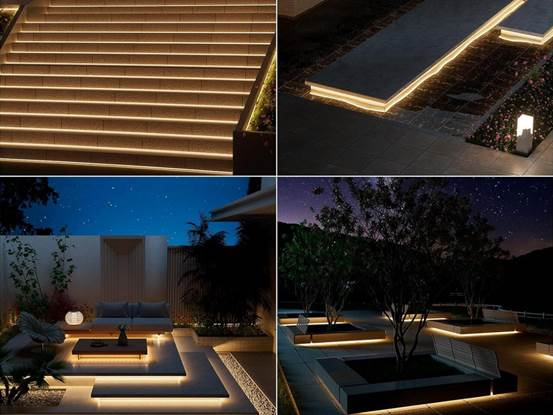
Introduction: Why Outdoor Lighting “Best Practices” Depend on Where You Use Them
When people search for outdoor waterproof LED lighting, they often assume there is a single “best” solution that works everywhere. In reality, outdoor environments vary far more than most buyers realize.
A lighting product that performs perfectly on a building façade may fail quickly when installed at ground level. A strip light suitable for a covered patio may be completely inappropriate for a garden pathway or water feature.
The key reason is simple: outdoor environments expose lighting systems to different types of water, moisture, dust, and temperature stress.
This article takes a scenario-based approach to help readers understand how the definition of “best outdoor waterproof LED lights” changes depending on application. Instead of focusing on abstract specifications, we will examine real-world outdoor use cases, explain the technical reasoning behind IP selection, and clarify common misunderstandings that lead to premature failures.
Covered Outdoor Areas: When Rain Is Not the Biggest Threat
Typical Scenarios:
- Covered patios
- Pergolas
- Balconies
- Canopies
- Semi-outdoor retail spaces
In these environments, lighting is technically outdoors but not directly exposed to rain. However, many buyers still choose extremely high IP ratings out of caution.
Key Environmental Characteristics:
- Limited direct water exposure
- Moderate humidity
- Dust and insects
- Temperature fluctuations
Recommended Waterproof Strategy:
For covered outdoor spaces, IP65 lighting is often ideal. It provides sufficient protection against dust and indirect water exposure without introducing unnecessary sealing that could trap heat.
Over-sealing in these areas often causes more harm than good, especially for LED strips that rely on airflow for thermal stability.
Open Architectural Exteriors: Constant Exposure to the Elements
Typical Scenarios:
- Building façades
- Exterior signage
- Outdoor linear accents
- Wall grazing and outlining
These applications face:
- Direct rain
- Wind-driven moisture
- Dust accumulation
- UV exposure
Here, waterproofing is essential—but immersion resistance is not.
Practical Considerations:
- Water usually flows downward, not upward
- Moisture dries naturally if drainage is adequate
- Heat dissipation remains critical
Best Practice:
High-quality IP65 outdoor LED lights with proper installation orientation perform exceptionally well in these scenarios, often lasting longer than fully sealed alternatives due to better thermal management.
read more : Helping children feel comfortable with numbers through everyday experiences
Ground-Level Installations: Where Most Failures Occur
Typical Scenarios:
- Walkways
- Steps
- Driveway edges
- Landscape borders
Ground-level installations experience some of the harshest outdoor conditions:
- Splashing water
- Temporary pooling
- Mud and debris
- Foot traffic impact
Many failures occur because lighting selected for vertical surfaces is incorrectly used at ground level.
Recommended Waterproof Strategy:
For ground-level applications, IP67 is usually the minimum safe choice. It accounts for temporary immersion and splashing, which are unavoidable near the ground.
This is one of the most common environments where IP65 is under-specified and leads to early failure.
Garden and Landscape Lighting: Moisture Without Immersion
Landscape lighting often exists in a gray area between architectural and ground-level applications.
Typical Scenarios:
- Garden borders
- Planter lighting
- Retaining walls
- Tree uplighting accents
Environmental Challenges:
- Soil moisture
- Irrigation spray
- Organic debris
- Seasonal humidity changes
While lighting may not be submerged, it is exposed to frequent moisture from multiple directions.
Practical Recommendation:
Depending on installation height and drainage, IP65 or IP67 may be appropriate. The deciding factor is not aesthetics, but water accumulation risk.
Water-Adjacent Installations: Splash Zones Are Not Submerged Zones
A major misconception in outdoor lighting is treating water-adjacent areas as submerged environments.
Typical Scenarios:
- Pool edges
- Fountain perimeters
- Waterfall accents
- Spa surroundings
These areas experience:
- Continuous splashing
- High humidity
- Chemical exposure (chlorine, salt)
However, they are not continuously underwater.
Correct Approach:
Many of these installations function reliably with IP67 lighting, provided waterproofing quality and installation details are correct. Automatically upgrading to IP68 can increase cost and reduce heat dissipation without delivering meaningful benefits.
Fully Submerged Applications: Where IP68 Is Truly Required
Typical Scenarios:
- Underwater fountains
- Pools
- Ponds
- Water features with constant immersion
In these environments, IP68 is non-negotiable.
However, even within IP68 products, performance varies widely depending on:
- Potting material quality
- Seal uniformity
- Cable entry protection
- Thermal design
Buyers should treat IP68 lighting as a specialized category, not a default choice.
Installation Orientation Changes Everything
One of the most overlooked factors in outdoor lighting success is how the product is installed.
The same IP-rated product may:
- Fail quickly when installed horizontally
- Perform reliably when installed vertically
Key Installation Factors:
- Drainage paths
- Cable exit direction
- Mounting surface material
- Exposure angle to rain
Scenario-based selection must always include installation planning, not just product choice.
Why Waterproof Rating Alone Is Not Enough
Two products with the same IP rating can behave very differently outdoors.
Reasons Include:
- Different waterproofing methods
- Material aging behavior
- Adhesive and sealant quality
- Connector protection
This is why experienced professionals evaluate system design, not just IP labels.
Redefining “Best” Across Applications
Across all scenarios, one principle remains consistent:
The best outdoor waterproof LED lights are not defined by maximum protection, but by appropriate protection for the specific environment.
To make informed decisions across different outdoor applications, buyers need a clear understanding of how IP ratings relate to real-world conditions. This practical reference on best outdoor waterproof LED lights explains how different waterproof levels are intended to function across various outdoor scenarios, helping readers avoid common application mistakes.
Common Application Mistakes to Avoid
Mistake 1: Using façade lighting at ground level
Mistake 2: Choosing IP68 “just in case”
Mistake 3: Ignoring installation orientation
Mistake 4: Treating all outdoor environments as equal
These mistakes account for a significant portion of premature outdoor lighting failures.
How Designers and Installers Benefit from Scenario Thinking
Scenario-based selection improves:
- Design accuracy
- Installation reliability
- Long-term performance
- Client satisfaction
It also reduces unnecessary cost escalation caused by over-specification.
Long-Term Performance Depends on Correct Matching
Outdoor LED lighting systems succeed when:
- Environmental exposure is correctly identified
- Waterproof protection is properly matched
- Installation details are thoughtfully planned
Failure usually stems from mismatch—not product defects.
Conclusion: One Keyword, Many Definitions of “Best”
There is no single universal answer to what constitutes the best outdoor waterproof LED lights.
Instead, “best” depends on:
- Where the lighting is installed
- How it is exposed to water
- How it is mounted and maintained
By evaluating outdoor lighting through application-specific scenarios, buyers can make smarter decisions, avoid costly mistakes, and achieve lighting systems that perform reliably for years.
In outdoor lighting, context defines quality.